
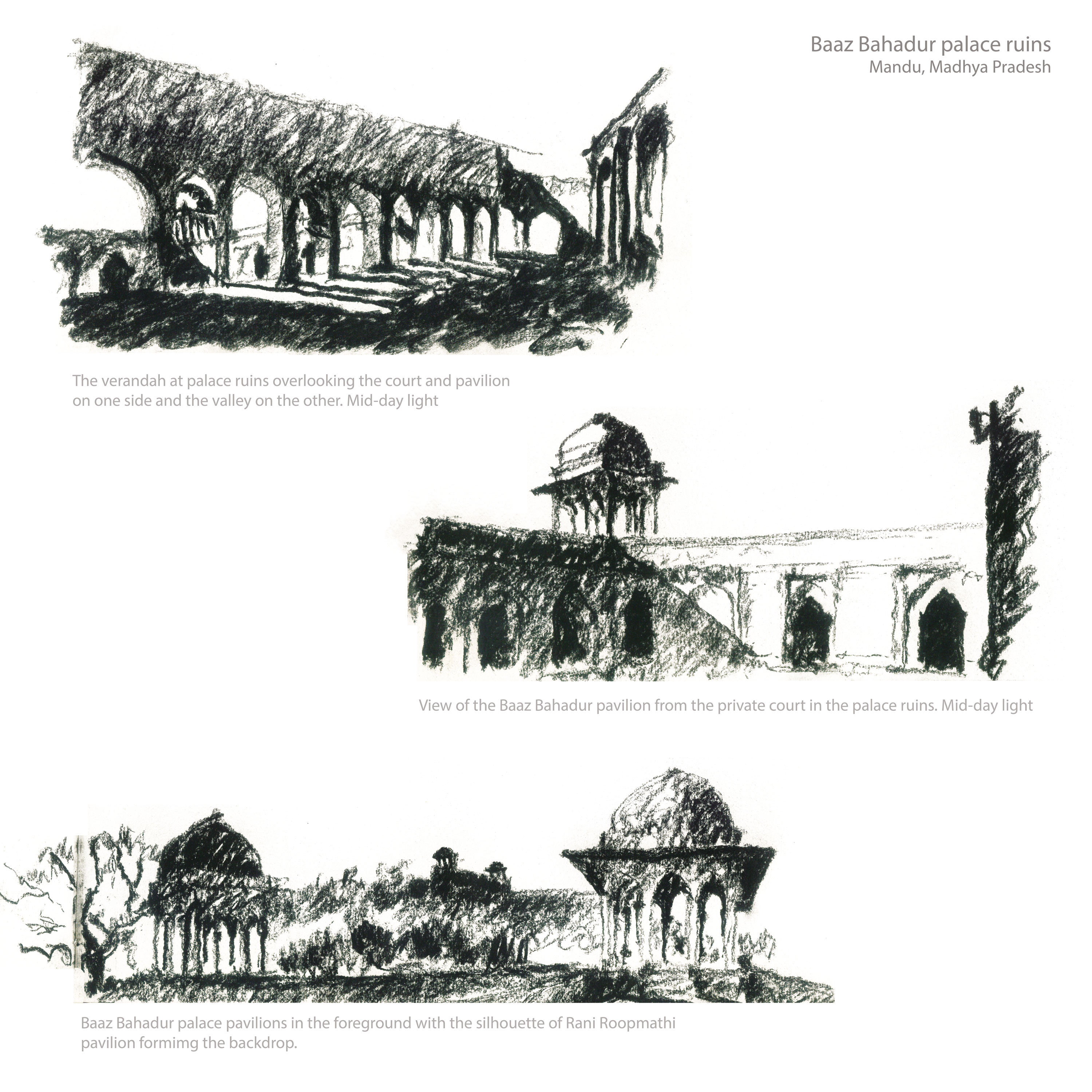
Travel sketching serves as a valuable tool for observation, and has allowed to capture the essence of significant architectural sites across India. These sketches are curated from my personal sketchbook, during a trip to Mandu in Madhya Pradesh offering insights into the spaces, landscapes, and design principles of these monuments.
The sketches of Rani Roopmathi pavilion primarily consist of cross sections that help depict spatial volumes and analyse landscape variations. Additionally, they highlight design principles like hierarchy, proportions, symmetry, and more. Environmental factors, such as the direction of sunlight, its impact on lighting, proximity to water bodies, and wind movement as experienced on-site, are also documented. On the contrary, the sketches from Baaz Bahadur palace ruins are done in charcoal to capture the form and the lighting of the space. An attempt to bring out the rawness of the ruins was also made.
In some ways, travel sketching goes beyond mere description and becomes a diagrammatic exercise for observation. Sketches are typically completed on-site to ensure important details are not overlooked. Timing the sketches is crucial during these exercises, helping one determine the level of detail required. The panels feature sketches ranging from long detailed illustrations to quick analytical sketches completed within minutes. While both capture experiences, the depth of observation may vary. The act of detailed sketching aids in preserving spatial qualities for those with photographic memory.
The methodology involves measuring one aspect of a space, such as a grid or height, and then sketching the space in proportion to that measurement. In cases where measuring tape isn’t available, I have used human heights as a reference for relative proportions. The resulting sketches are mostly proportional rather than precise.
An elongated cartridge sheet sketchbook is often preferred for longitudinal sections. The choice of mediums includes a 2B pencil, gel pens of various precisions, watercolours for the base illustrations and willow charcoal. Watercolours are particularly effective for creating depth through layering while charcoal allows one to quickly capture the essence of a space through varying intensities in strokes.
 FOLIO
FOLIO 