These drawings were made during the studio: Between Fractures, Fields and Flows by Percy Pithawala. The studio explored lateral inter relationships between various design fields and their influences on architecture whose understanding may help them frame their individual thought within a process-based approach the site lies in between the iconic Brandenburg gate and Peter Eisenman’s Holocaust Memorial in Berlin. Remnants of ‘The Berlin Wall’, which divided the city into East and West, were taken as a point of departure to weave narratives and conceptual strategies for design of “The Wall Museum”. Upon studying the history of the wall, one could feel the disregard shown towards the identity of the individual. A moment in time when international politics triumphed over the feelings of the imprisoned human; when the highly cherished human conscience was forsaken by one’s greed for power. The project is design led research that aims to challenge the anthropocentric creation of architecture which has been prevalent in Europe since the Enlightenment. As Freud identified; the imperfection of the human condition demonstrated across the twentieth century and our insufficient knowledge of the human body compels us to break away from tradition and find new ways to create architecture. One such process was introduced in Peter Eisenman’s scaling during the 1980s, which the project emulates in creation of architecture.
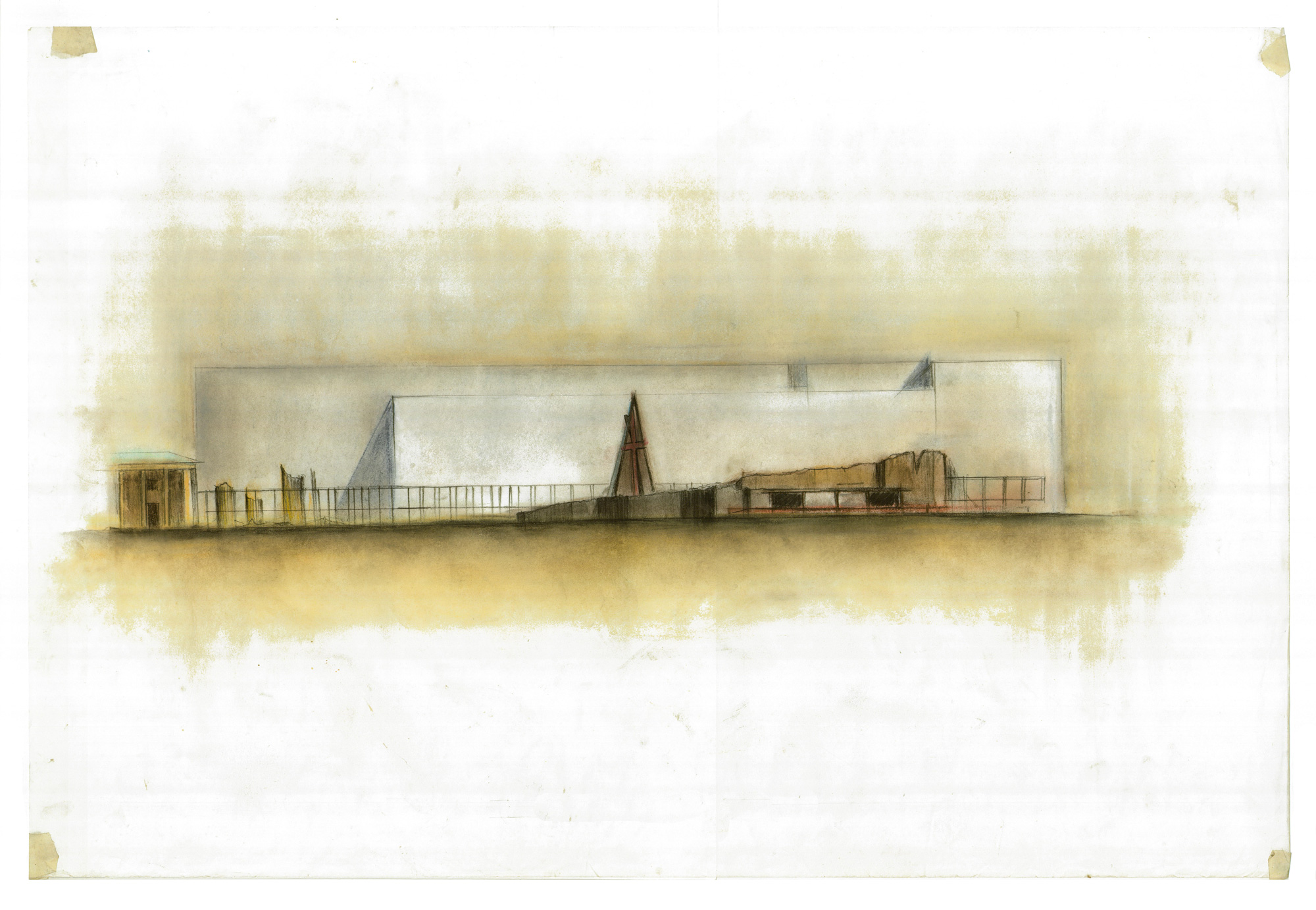
DRAWING 1: Front Elevation; Soft Pastels on White Tracing Paper; Size 30’ X 20′
The drawing depicts the front elevation of The Wall Museum, Berlin. Layers of artificially excavated fort walls are aestheticized as ruins emerging from the ground, taking over the ‘modern’ program of the museum. The intention is to create a non-building expression that frees up the urban edge that the site is. The grid tracing the ‘displaced’ Berlin Wall extends towards the Brandenburg Gate (left). Scaled ruins of the columns appear at this intersection, forming room, support conditions and chairs. As a representational response to distinguish between these layers, one developed a colour intensive.
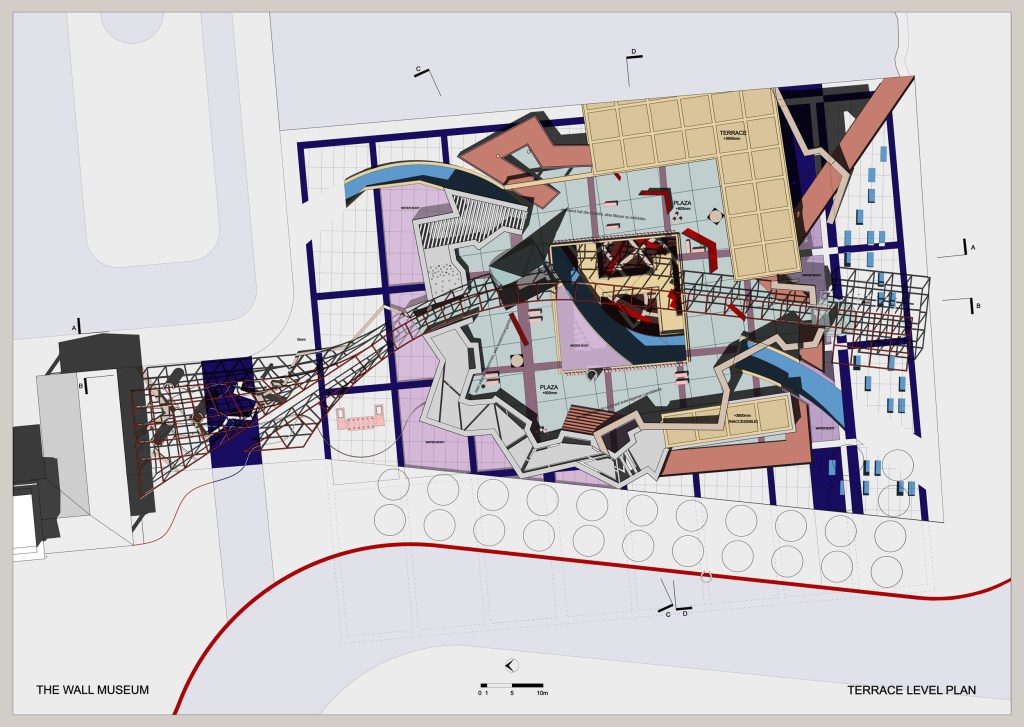
DRAWING 2: Terrace Plan Digital Illustration (Sketchup + Auto CAD + Illustrator +Photoshop) Size 30’ X 20′
The museum is imagined a palimpsest that reveals the excavated layers associated to the narrative of the Berlin Wall. A square cut out at the centre becomes the datum for organisation and frames the excavations in the basement. It allows for the creation of a plaza enclose d by fort walls of different scales and the modern programme of the museum whose block is designed in a quintessentially rational manner. The trace of the Berlin Wall, which is displaced on to the site, cuts through this plaza, framing views along both sides.
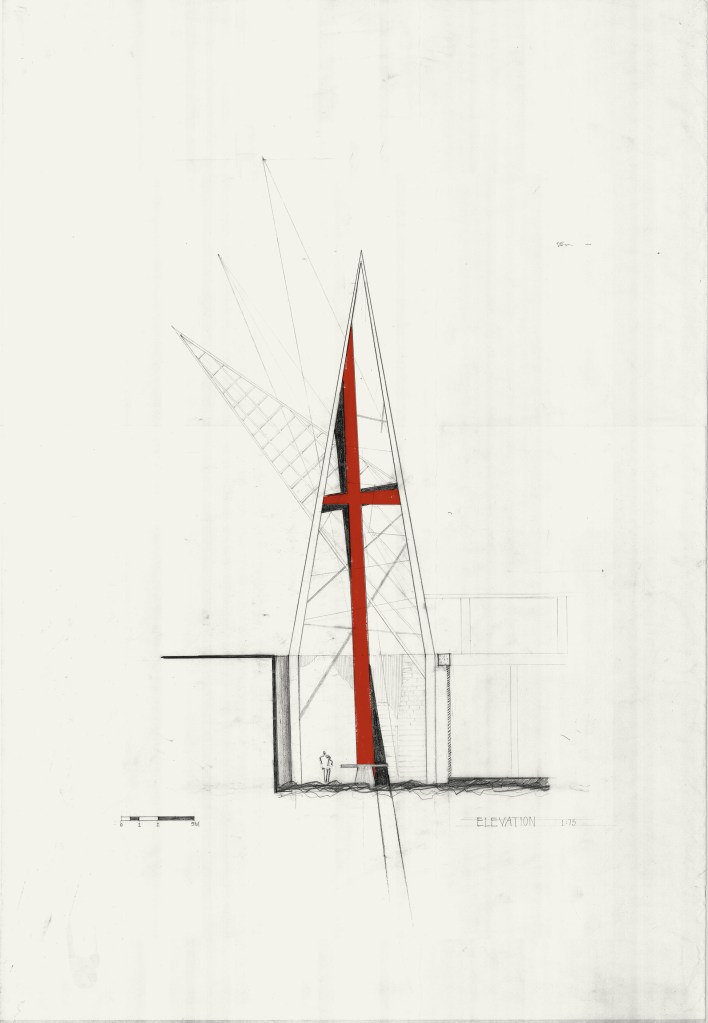
DRAWING 3: Elevation of the Excavated Chapel; Pencil on White Tracing Paper + Photoshop; Size 20′ X 30′
The drawing imagines an excavation of the Chapel of Reconciliation, which was demolished some years after the wall was erect. A n arbitrary line draw n on a map decided the fate of this centre of meaning and faith. The artificial excavation digs out half of the helm roof of the chapel. Th is unstable roof us supported by two crosses (Red and Black). The composition takes inspiration from Russian avantgarde painter Kazimir Malevich s works.
Note: These drawings were executed as studio projects for AR 3030 ‘Between the Fractures, Fields & Flows’ – Spring Semester’ 23, L 3 Studio, CEPT University undertaken by Professor Percy Pithawala.
 FOLIO
FOLIO 